More customers are asking us about RFID labels, usually because a retailer or distributor brought it up first. RFID is one of the newer options in our custom label printing, and it can change how you count, ship and track product. Here is what an RFID label is, what it changes, and what to settle before your artwork is final.
How an RFID Label Works
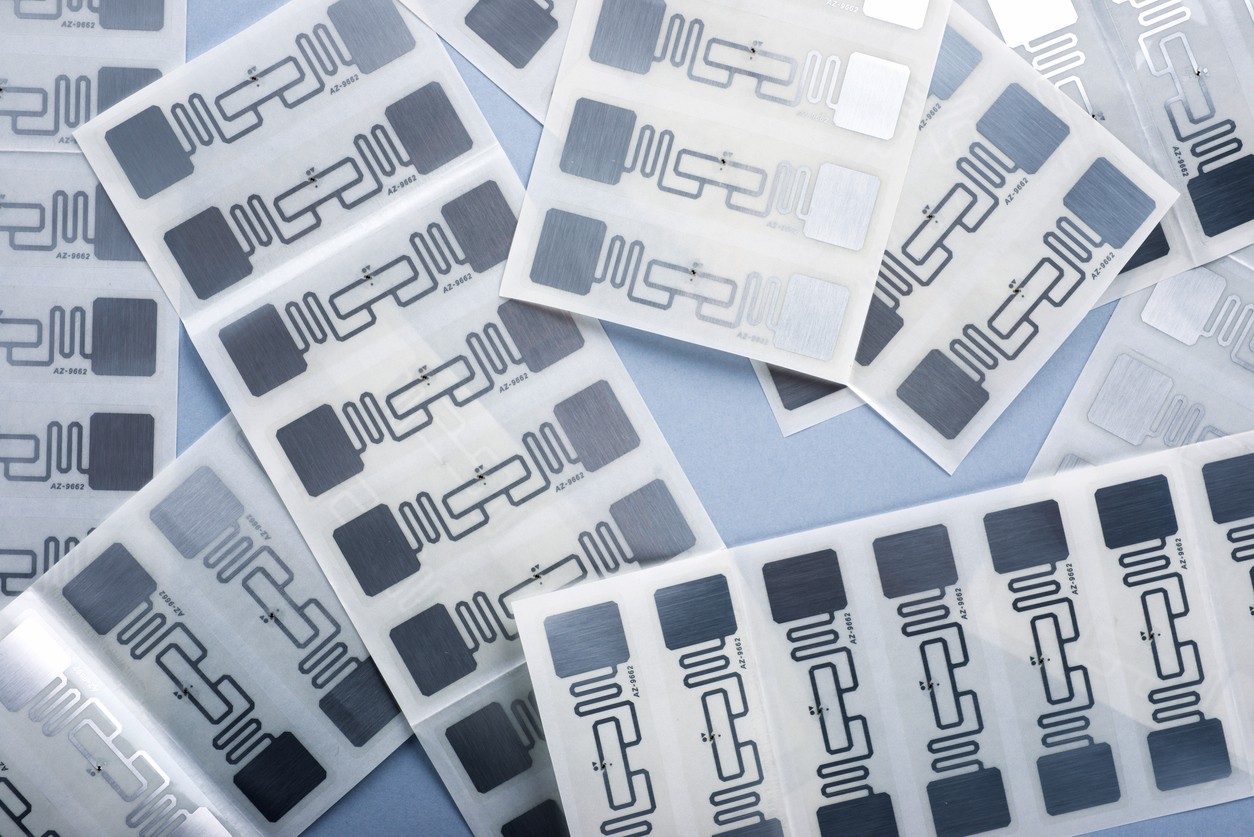
Inside the label sits an inlay: a small chip attached to a thin antenna. Most RFID labels are passive, with no battery. A reader sends out a radio signal, the antenna picks it up, and the chip answers with its stored ID. On the outside it looks like any other label, with your artwork, a barcode and readable text.
RFID vs. Barcodes
A barcode has to be seen to be scanned. RFID does not, which changes how fast you can count and track.
- No line of sight: tags read through a carton, tote or shrink wrap.
- Many at once: a reader can count a full case instead of scanning one item at a time.
- Unique per item: each tag can carry its own serial number, not just a product code.
- Barcodes still win on cost: if you scan a few items by hand, a barcode does the job. Many RFID labels carry a printed barcode too, as a backup.
What Changes Day to Day
The label is the small part. The bigger change is all the scanning, counting and checking you no longer do by hand.
- Inventory counts without the shutdown: instead of scanning every item, someone walks the aisles with a handheld reader. Counts happen more often and take less labor.
- Shipping and receiving that checks itself: a case or pallet can be read as it passes a dock door, so short or wrong shipments get caught before they go out.
- Ordering on real numbers: when counts are accurate, you reorder based on what is on the shelf, not what the system guesses. That means fewer stockouts and less overstock.
- Traceability for recalls and returns: a unique serial number on each item lets you trace it to a lot, a ship date or a customer.
- Loss prevention and authentication: tags can help flag missing stock and prove a product is genuine.
- A direct line to your customer: an NFC tag lets a shopper tap a phone to see product details, reorder or register a warranty.
The rule of thumb: if you need to count a lot of items quickly and can’t always see them, RFID is worth a look.
A Market That Keeps Growing
RFID is no longer just for big-box supply chains. The numbers show how fast it is spreading.
- Shipments are way up: chip makers shipped 52.8 billion RAIN RFID tag chips in 2024, a 54% jump in two years, according to the RAIN Alliance.
- A pause, not a reversal: 2025 dipped to 42.7 billion as tariffs and retail destocking slowed orders, but shipments are still up about 50% over four years (RAIN Alliance).
- More growth ahead: VDC Research projects more than 115 billion tag chips a year by 2029.
- Lots of room left: less than 1% of the items that could carry a tag had one in 2025 (Counterpoint Research).
- New industries: retailer requirements are spreading past apparel into beauty, home goods and electronics, and adoption is growing in food, pharmaceuticals and sports equipment.
If your customers have not asked about RFID yet, they may soon. Starting early gives you time to test before it is a requirement.
When RFID Makes Sense
- A retailer or distributor asks you to tag certain products. Check their current requirements before you order.
- You count large volumes of inventory or returnable containers.
- You need item-level serial numbers for traceability or authentication.
- Miscounts, lost shipments or shrink cost more than the label upgrade.
Choose the Tag for the Job
We work with Avery Dennison, the largest UHF RFID supplier in the world. Their inlays cover UHF, HF and NFC, so we can match the tag to your product instead of forcing one option to fit.
- UHF: the most common choice for inventory and shipping. It reads from several feet away and in bulk.
- NFC: reads with a phone tap at close range. It is used for product information, authentication and customer engagement.
Watch the Surface
Metal and liquid can block or weaken the signal. Canned goods, metal parts and bottled liquids may need a tag built for that surface, or a different placement. Tell us what the label goes on and we will match the tag to it.
Plan Artwork Around the Inlay
- The inlay adds a slight bump. Keep barcodes and small text off it.
- Keep it away from edges, folds and tight curves where it can crack.
- The label has to fit the inlay, so settle size before artwork.
- Decide whether tags arrive encoded with your data or get encoded on site with an RFID-capable printer.
Test Before a Full Run
Request sample labels, apply them to real product, and read them with your equipment in the space where they will be used. Read ranges on a spec sheet are measured in ideal conditions, and a busy warehouse is not one. A short test catches placement and surface problems before they show up on thousands of labels.
We print and supply RFID labels alongside the rest of our custom label printing. Related reading: